Mental-Arithmetic.co.uk
Free mental arithmetic worksheets for children aged 4-11
Welcome to mental-arithmetic.co.uk - a website offering a vast selection of FREE printable mathematics worksheets for children aged from 4-11 years.
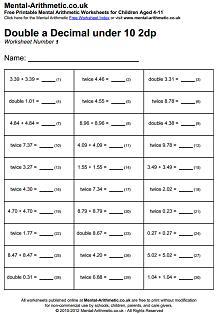
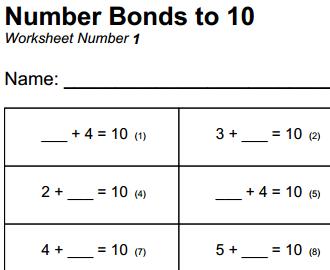
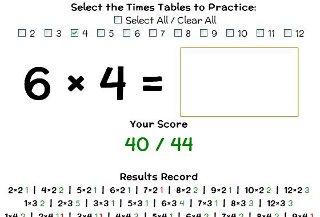
Worksheets currently include addition, subtraction, number bonds, times tables, number sorting, and much more.
All worksheets are provided as PDF documents for easy printing.
NEW 2021 - Multiplication Wheel Worksheet Generator and Telling the Time Worksheet Generator
and Angles and Triangles Worksheet Generator
Worksheets currently include addition, subtraction, number bonds, times tables, number sorting, and much more.
All worksheets are provided as PDF documents for easy printing.
NEW 2021 - Multiplication Wheel Worksheet Generator and Telling the Time Worksheet Generator
and Angles and Triangles Worksheet Generator
| ||
Mental MathsBy developing strong mathematical foundations and an early understanding of numbers and arithmetic, children will find the rest of their mathematical education more interesting and much easier to grasp. They are also likely to get a lot more from their studies of science and technology in the future.
3+4 will always equal 7, 4x5 will always equal 20, and so some rote learning (learning by repetition and/or memorisation - in this case with worksheets) is a suitable and efficient way to practise and develop mathematical skills and techniques so that they become second nature; hard-wired number facts in a young person’s brain. You don’t have to think when asked what is 2+2: you just know that it is 4. The sooner that a child just knows certain number facts, the better, but that knowledge comes only through practice.
Rote learning is often frowned upon in modern education - understandably in most subjects - however with elementary mathematics some rote learning is essential. The way that reading is taught has changed a lot over the years with phonics now favoured, but the phonic sounds themselves are still taught to 4 and 5 year olds using rote learning - there is no better way. Only with those first basic building blocks securely in place is it then possible to teach reading. Similarly with mathematics, once strong foundations have been built, a whole new world opens up before a child. Without the right basic mental tools a child will always struggle with mathematics, and therefore with many other subjects too. Of all the mathematics taught in schools, it is that taught to children before the age of 11 which is most important in the rest of their lives. Most people will never use anything they learn in mathematics lessons after that age in their adult life, but good basic number skills and mental arithmetic ability will remain a powerful tool to have and use every day. Teachers or parents can initially work through the worksheets with the children in their care to ensure they have a good understanding of the technique(s) to be practised. Children can then finish the worksheet and complete further worksheets independently. Try out our interactive Addition by Partitioning, Column Addition, and Column Subtraction tutorials. Click here for a wide selection of Mental Maths workbooks and teaching resources. Contact usIf you would like to contact us for any reason please email info@mental-arithmetic.co.uk and we’ll get back to you as soon as possible. We are particularly interested to hear any suggestions for new types of worksheets you would be interested in seeing added to our collection. We hope to hear from you soon. |
All worksheets published online at Mental-Arithmetic.co.uk are free to print without modification
for non-commercial use by schools, children, parents, and care givers.
© 2010-2021 Mental-Arithmetic.co.uk - All Rights Reserved - (Privacy Policy)